
(November 8 2025)
I could see the infectious delight on my student Manas’s face when he told me that we would be going on a sightseeing tour after the conference. My students, Radha and Binayak, were excited when they realized that they would be taking me around that evening. Along with Manas’s colleague, Debasmita, we set off from Pattamundai College to Ichhapur, a journey of approximately one hour through villages and green fields. As we travelled, we discussed a number of presentations that we had heard, and I also learnt a great deal about Odia women writers – an area that I had previously been ignorant about.
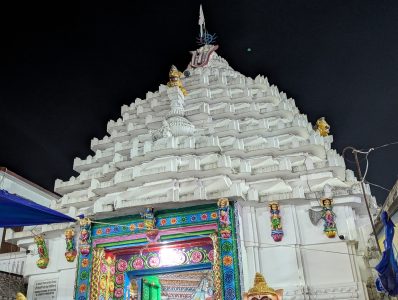
The temple in Ichhapur is devoted to Lord Balabhadra (popularly also known as Balarama), the elder brother of Lord Jagannath (Krishna). Locally, it is known as the Baladevjew temple.
Historical records document that a temple was built in the 10th century AD by King Jajhati Keshari. The earlier temple was destroyed by the Mughals around the 1660s. The deity was secretly taken by the devotees over the river Govari & stored in a jungle. Many years later, it was found by a shepherd and reinstated in what is now Ichhapur. It is also believed that Balabhadra married Goddess Tulasi in this region and resided here.
The region of Kendrapara was ruled by the Maratha rulers in the 18th century. The latter temple is believed to have been built by the ruler of Kujanga, Raja Gopal Sandha, along with the local zamindar and others. The temple also houses Goddess Tulasi in the form of an idol, visible as soon as one climbs the seven sacred steps leading to the shrine. Since the goddess Tulasi is worshipped here, the area is also known as Tulasi Kshetra. Lord Baladbhadra is the presiding deity here, accompanied by his brother, Lord Krishna, and sister, Subhadra. An important part of the ‘bhog’ to the god is the sweet dish, Rasabali.
According to mythology, the presence of Balarama also explains how the Kendrapara district came to be named. A demon king named Kandarasura, also known as the destroyer of yagnas, ruled over the area and terrorised the people. To vanquish him, Lora Balabhadra fought and defeated the demon. Kandarasura fled to the Kapila hills and began praying to his ‘Ishtadevata,’ Lord Shiva. In his search, Balabhadra ploughed the hill, which created a perennial rivulet; And this is also the reason why the idol in the temple has a plough in one hand. Eventually, he killed the demon, cut his body into pieces, and scattered them across the land. From this act emerged the name Kandharapara (kandha meaning body parts), which later evolved into Kendrapara. According to legend, before killing the demon Kandarasura, Lord Balabhadra first slew Madhudaitya, Kandarasura’s chief military general, at Lalitagiri with his plough. The blood that flowed from the fallen general is said to have given rise to the river Madhusagar (present-day Gobari River), which runs eastward before meeting the sea.
Afterwards, Balarama married the asura’s daughter Tulasi and, before leaving, established himself as a deity who could be worshipped by the locals.
Although the main deity is made from stone, the Jagannatha and Subhadra idols are carved out of wood. The main temple is constructed as a seven-layer construction. The site is also known by several other names, such as Gupta khetra, Sri Baladeba khetra, and Manibigraha khetra. The main deity is depicted holding a club in one hand and a plough in the other.
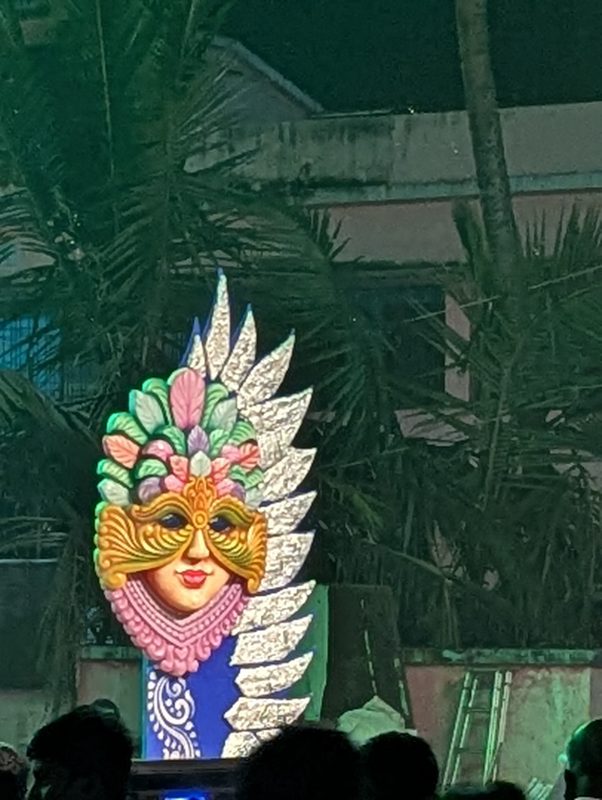
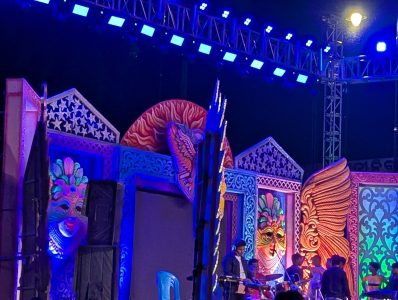
As we savored the prasad, we silently sat, enjoying the peace and serenity around us, while I reminisced about the past and thought about how culture bonded us. Just as we were about to drive back, we noticed preparations underway outside for a performance, held in celebration of ‘Kartik Purnima ‘and ‘Boita Bandana’. The makeshift stage, once again, stood as a testament to the creativity and imagination of the artists.