

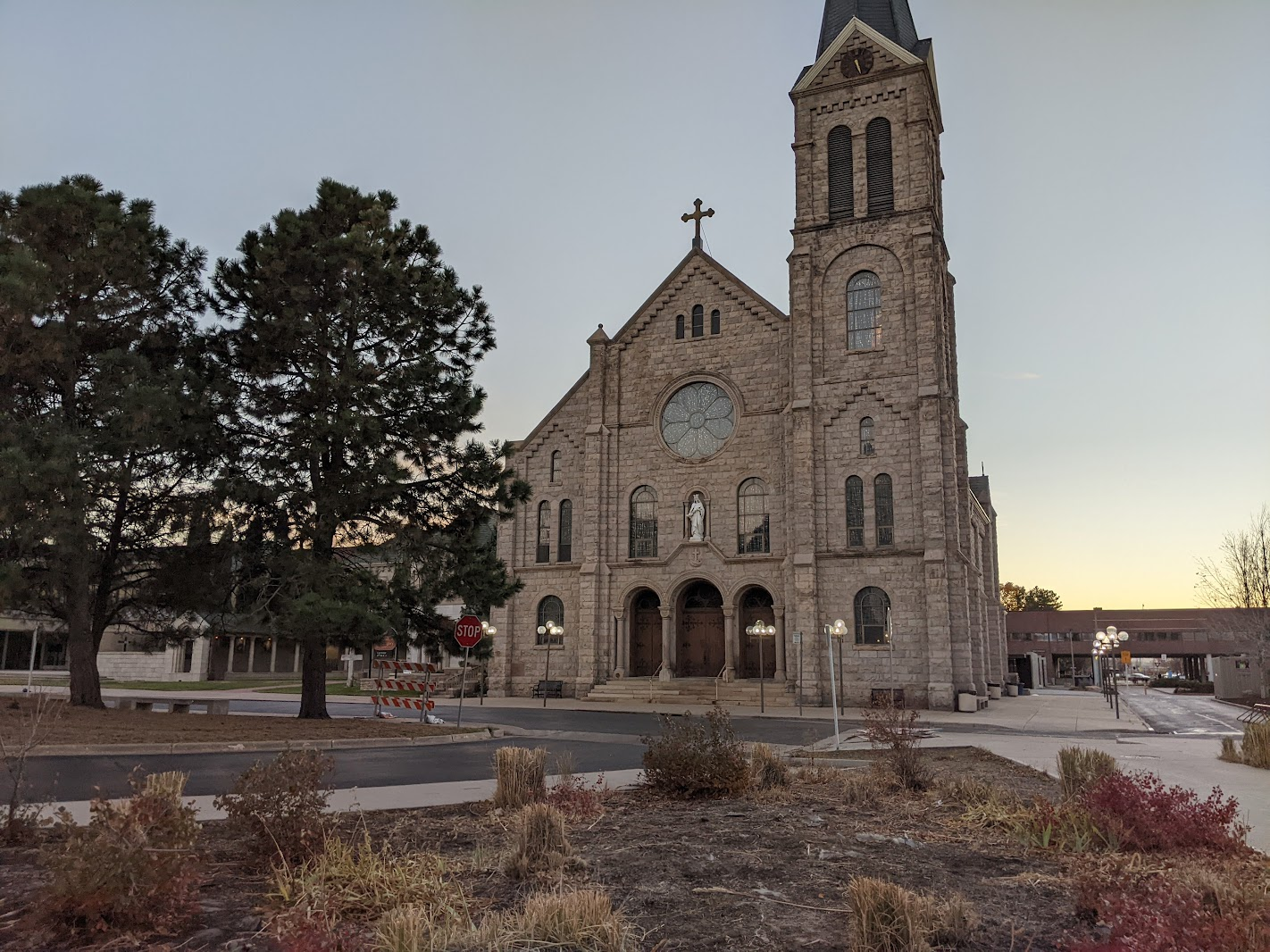
by H. Kalpana Rao, from Auraria Campus, Denver
Many universities have small religious shrines on their campuses; hence it is not surprising that the Metropolitan State University at Denver too has a church on its campus. However, what is interesting is that there are three churches that are located on the campus: the Roman Catholic Church of St Elizabeth of Hungary, the St. Cajetan’s Church and The Emmanuel Gallery. Of these, the St. Elizabeth of Hungary Church is the only working church.
Immigration into Denver happened due to the creation of the railroad. Many families that migrated to Denver and that settled on the bank of the Cherry Creek in the mid-19th century were of German ancestry. These German settlers needed a church for their prayers and as a result, in 1879 the foundation for Saint Elizabeth Church was laid.
Who is St. Elizabeth of Hungary? St. Elizabeth of Hungary was born probably as per records around 1207 into a noble family in Hungary. She was bethrothed to a German noble man in Thuringia. Hence, she is also known as Elizabeth of Thuringia. Influenced by St. Francis of Assisi, she led a pious life taking care of the poor and hungry. She is therefore known as the patron saint of “bakers, beggars, brides, charities, death of children”.
The church built in Denver began to have big gatherings and to accommodate the church goers a new one was built in 1898 that was designed by Father Adrian. It was constructed using Rhyolite (a type of lava stone) from the region of Castle Rock in Colorado. From 1910 to 1920 the neighborhood in and around the church began to decline and the region was occupied by low income groups and by small industrial plants. In 1968 the church was renovated and in 1969 the church was declared a Denver landmark. In 1983 the Franciscans handed over the church to the Capuchin order, thereby bringing hundred years of Franciscan order to an end.
An important aspect of this church is the tradition of caring for the poor and hungry. This is represented by a small statue right in front of the church. The church has been known as a friend of the poor as some of the Franciscan fathers opened their doors to provide free food for the needy and poor. In 1936, the May Bonfils Trust constructed the friary which is made up of colonnades and stained window glasses. In 1973, the gentrification of Auraria started destroying a large part of the heritage of the Auraria neighborhood. Due to few conservationists, the church had been declared as a Denver landmark and when the Auraria Higher Education Center came up as an educational institute, the church became a part of the campus chapel. A unique feature of this church is the adoption of two different church traditions, namely the Roman and the Russian. It is one of the few places of Christian worship that has a blend of the East and the West rituals and liturgy. The church was also notably a site for an assassination in 1908, when the father Superior then, Leo Heinriches was shot by, probably, a mentally ill man. The Church is an imposing Gothic structure, a reminiscence of the multicultural nature of Denver.